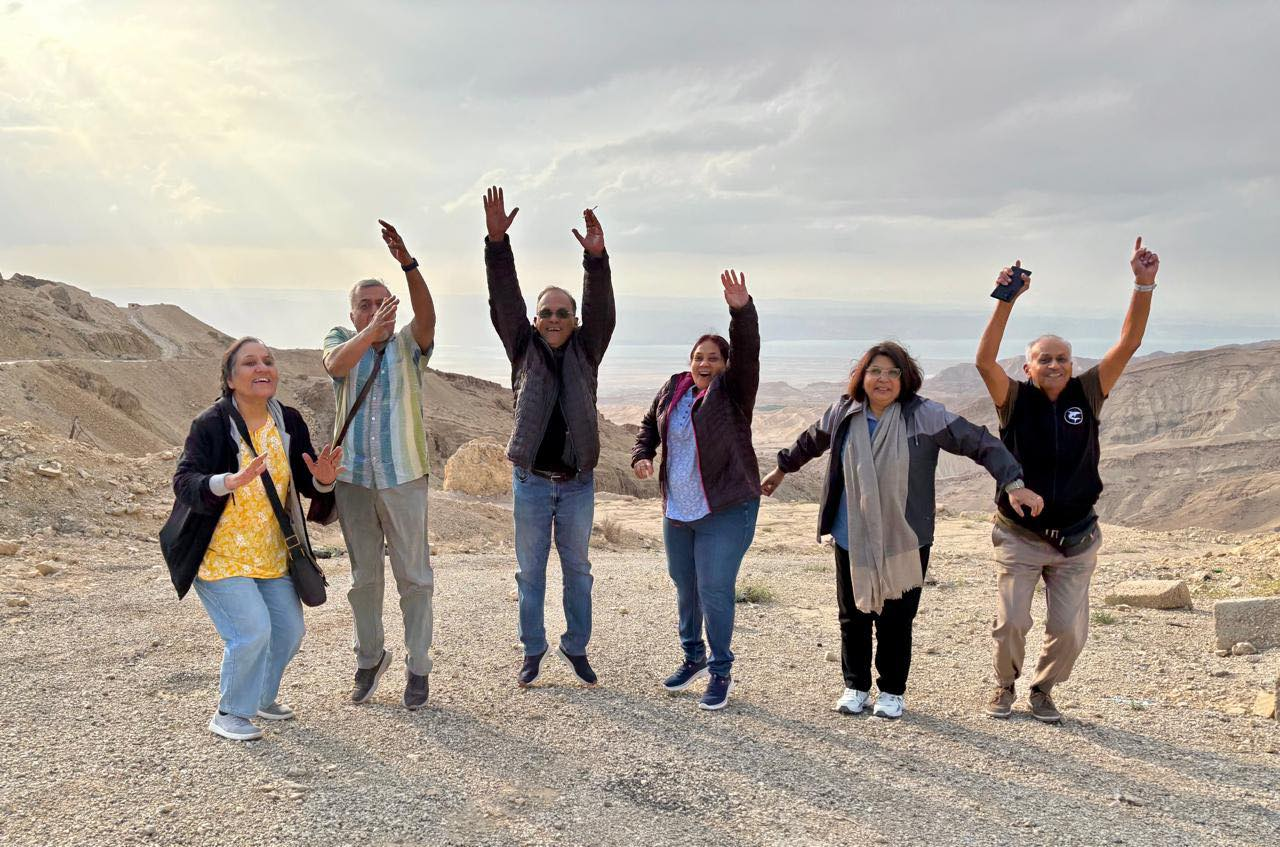
I have been to Hazratganj for shopping, for chat, for meals or for just “Ganjing” a favourite pastime of all Lucknowites. But, last Sunday I went to Hazratganj to explore the hidden stories some lost with time, some lost in plain sight. As is common in Lucknow every locality here is associated with history…be it the Nawabs, the First war of Independence, the British, and even our freedom struggle. Hazratganj too has a rich past full of historical vibes. The walk was superbly curated by Shri AK Srivastavaji and Shri Pradeep Kapoorji!
We started from the Laxman Park near the stadium, where stands a memorial to a group of English and Indian soldiers killed by Indian freedom fighters, and the site of the hanging of Raja Jai Lal Singh by the British. One passes this way frequently but never realizes its historical significance. We moved on to the main branch of SBI, which was once an astronomical observatory. Called the Tarowali Kothi, it housed instruments from Greenwich, London, and was one of the best works in astronomy in India around 1841. It fell out of favour under the last Nawab, Wajid Ali Shah, and was shut down. Later it was also the centre where strategy was being decided under the guidance of Raja Jai Lal Singh. Burnt and destroyed by the British after 1857, it later housed the Bank of Bengal, then Imperial Bank, and in its current avatar, the Main Branch of SBI. From starry heights, to nerve-wracking war games, and now to the grounded reality of money matters, this kothi has seen it all.
We move a few metres ahead to the office of CPMG, the Post Master General. In its original form, this magnificent building was the “ Ainakbaaz kothi,” a name given due to its opulent interiors of mirrors and glass.
There was a Kankar kothi nearby, which is now lost. Lucknow has numerous kothis built by the Nawabs, the Rajas, and the Taluqdars. Hazratganj itself is lined on both sides by some imposing kothis starting from Kothi Noor Baksh, which is now the residence of the District Magistrate, all the way to Kothi Hayat Baksh, which is now the Raj Bhawan.
From the Ainak wali kothi, we crossed the road and walked down to one of the most beautiful monuments, the Sibtainabad Imambara. Maintained beautifully, yet encroached upon, damaged beyond repair this place is an example of how callously we treat our heritage. The imposing gateway now has houses built into it! Unimaginable but unfortunately true. We could see ACs installed in the window of the room in the upper floor 0f the gateway. An address,1 Maqbara gate, and a monument is taken over. We walked in expecting to be shocked by more encroachments, but what we saw was a pleasant surprise. The Imambara is beautiful with green walls, four arched doorways with stained glass panels. It houses the grave of Nawab Amjad Ali Shah, also known as Hazrat, who gave us our ultimate shopping and walking destination. Such a marvel of history and architecture hidden in plain sight amid the hustle bustle of Ganj. Another interesting trivia. At one point the Imambara was also used as a church by the British, before they built their church where Cathedral stands now.
The historical perspective given to us by Srivastavaji, who, with his map, old photographs, and vast knowledge and passion for the city makes us visualise the place as it was in days past. I love to close my eyes and see the river meandering visible, from Ganj, Dilkusha gardens, which stretched till Raj Bhawan, the Chaupar stables now Lawrence Terrace, the imposing Cathedral, then only a small church in the design of all churches.
And from the Imambara, Pradeep Kapoorji takes over. This is the anecdotal part of the walk and we are treated to a feast of stories of the glory days of [Mayfair and other places of this elite market.It did break my heart to be standing in front of the staircase, shuttered now, where once we had watched movies like My Fair Lady and BenHur. The British Council Library on the first floor has been wound up. We heard about the three Sindhi gentlemen Thadani, Advani and Mansukhani who gave modern Lucknow its best places. Tales of car parking in the centre of the road, Ranjana and Annapoorna, Royal Cafe which was at one point near Halwasiya, the origins of Sahu film hall. So many more. Maybe, we can have a story telling session in the India Coffee House!
But history was not over yet. We moved to Janpath, another favourite shopping place in Hazratganj. Not a plaque,not a stone, not a board to tell us this was, once upon a time, Begum Kothi, part of the Kaiserbagh [complex. It was also the place of a bloody battle between our freedom fighters of 1858 and the English forces. Some 800 people were martyred, burnt, thrown, and buried in a ditch that surrounded the Kothi. But nothing to commemorate this resistance.
This walk has been one of surprises, two heartbreaks, awe at a glorious Imambara, and more importantly, an understanding of the history of Lucknow in a correct perspective. Away from the Nazakat-nafasat-Tehzeeb view of Lucknow, it gave us an understanding of the city, its past and its evolution in a measured manner, and the numerous stories and events that swirl around its roads, ruins, and buildings.
A special thanks to Aadaab Arz Lucknow for this fascinating event and to co-walkers who made the three hours very lively.